


What are the Warning Signs of a Pinched Nerve?
A nerve can become irritated when surrounding structures place pressure on it, and the resulting symptoms are not always limited to straightforward pain. Some people notice a strange tingling sensation, an area that feels less sensitive than usual, or weakness that makes a familiar movement harder. The location of the affected nerve influences where these changes are felt. Our team at Advanced Spine Care & Pain Management looks at the entire symptom pattern to distinguish possible nerve-related problems from other sources of discomfort. Triple board-certified Dr. Shailesh S. Pathare, MD, helps patients investigate unusual nerve-related sensations and determine what may be contributing to their symptoms. For more information, contact us today or book an appointment online. We are conveniently located at 565 Jewett Ave, Staten Island, NY 10302.
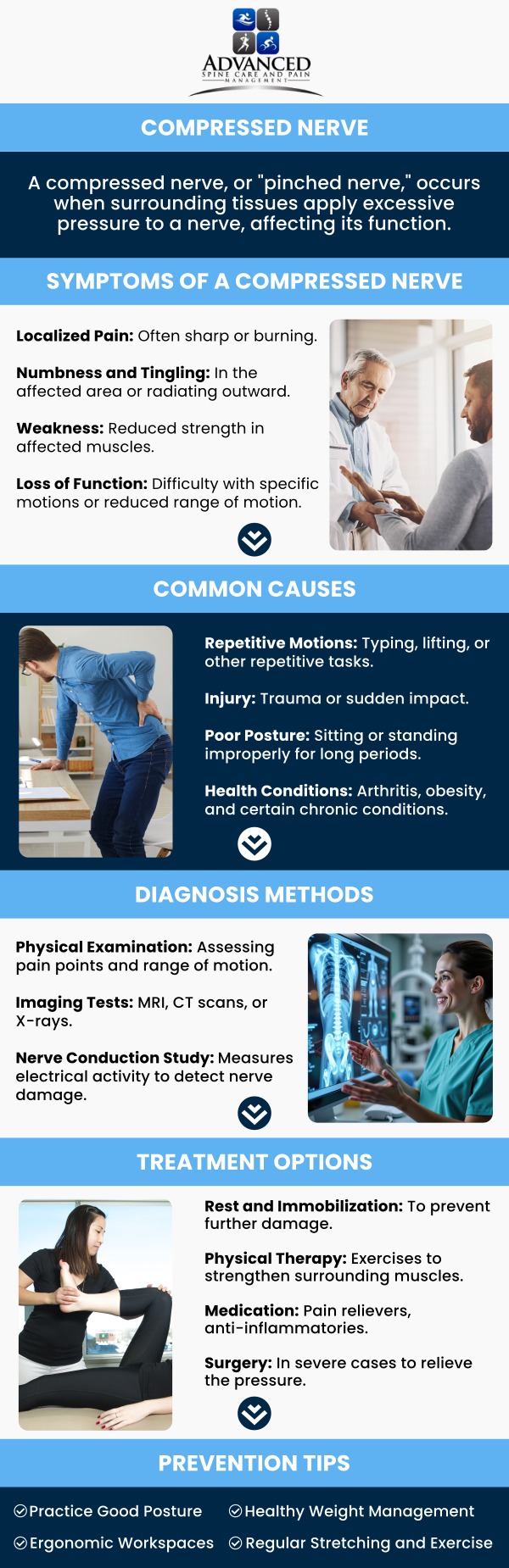
Table of Contents:
What are the most common symptoms of a pinched nerve?
Why can a pinched nerve cause pain, tingling, or numbness?
How can a pinched nerve affect movement and daily activities?
When should you seek medical evaluation for possible pinched nerve symptoms?
What factors can contribute to developing a pinched nerve?
How is a pinched nerve diagnosed during a medical evaluation?
How can Dr. Shailesh S. Pathare, MD provide personalized evaluation and treatment guidance for patients experiencing pinched nerve symptoms?
A pinched nerve can announce itself through sensations that seem unusual or difficult to describe. Burning, prickling, pins-and-needles feelings, aching, or numb patches are possible. In some cases, discomfort may seem to move along an arm or leg rather than staying in one precise spot.
Weakness is another potential clue. A person might notice that a hand does not grip as firmly, an arm feels less capable during lifting, or a leg does not respond normally during certain movements. Symptoms vary according to the nerve involved, so one person’s experience may look quite different from another’s.
At Advanced Spine Care & Pain Management, our team pays attention to the specific combination of sensations, weakness, and functional changes when assessing a possible pinched nerve.
Nerves act as communication pathways carrying signals between the body and the central nervous system. When one becomes compressed or irritated, those signals can be altered. Instead of producing normal sensation, the affected nerve may generate messages interpreted by the brain as pain, tingling, or reduced feeling.
This explains why nerve-related symptoms can sometimes feel unusual compared with ordinary soreness. The sensation may travel along the pathway served by the nerve and can appear in a body area that is not directly beside the source of the compression.
Our team at Advanced Spine Care & Pain Management considers these patterns when determining whether a patient’s symptoms could involve nerve irritation.
The practical effect of nerve irritation depends on which part of the body is involved. Symptoms affecting an arm could make typing, opening containers, carrying objects, or reaching more difficult. When a lower-body nerve is involved, walking, climbing stairs, standing, or maintaining a normal stride may become uncomfortable or challenging.
Persistent numbness can create another layer of difficulty because the affected area may not feel normal during everyday tasks. Weakness can be particularly disruptive when it changes what a person can safely or comfortably do.
At Advanced Spine Care & Pain Management, our team asks about these day-to-day changes because functional limitations can provide valuable context during an evaluation.
Occasional tingling after sitting or sleeping in an awkward position may disappear once pressure is relieved. Symptoms deserve greater attention when they persist, repeatedly return, spread, or begin interfering with ordinary activities.
Progressive weakness should not be dismissed, particularly when it affects the ability to walk, grip, lift, or control an extremity. Sudden severe weakness, new loss of bladder or bowel control, or numbness around the inner thighs or genital region requires urgent medical assessment.
For symptoms that are persistent but not an emergency, Advanced Spine Care & Pain Management can provide an evaluation to determine whether the problem appears consistent with nerve involvement or warrants further investigation.
Pressure on a nerve can develop in different ways. Changes involving spinal discs or the spaces through which nerves travel can narrow the available room around a nerve. Swelling, inflammation, repetitive positioning, or other structural changes may also contribute depending on where the problem occurs.
Activities and body positions that repeatedly place stress on a particular area can sometimes aggravate an already irritated nerve. However, the presence of one possible risk factor does not establish the cause of a person’s symptoms.
At Advanced Spine Care & Pain Management, our team looks at the patient’s history, symptom distribution, physical findings, and other relevant information to investigate what may be behind the nerve-related complaint.
There is no single symptom that confirms a pinched nerve. The diagnostic process starts with the patient describing what they feel, where it occurs, when it began, and whether particular movements or positions change the symptoms.
A physician may then assess muscle strength, sensation, reflexes, movement, and other neurological findings. If the initial assessment suggests that a deeper structural problem may be involved, diagnostic imaging or additional testing can be considered to obtain more information.
At Advanced Spine Care & Pain Management, our team uses the findings from the evaluation to determine what additional investigation, if any, would be useful before selecting treatment.
Triple board-certified Dr. Shailesh S. Pathare, MD, approaches possible nerve compression by looking for the connection between a patient’s symptoms and their underlying cause. Rather than focusing only on the intensity of pain, the evaluation can consider sensory changes, weakness, symptom distribution, duration, previous treatment, and how the problem affects everyday function.
Once the likely source has been investigated, Dr. Pathare can discuss appropriate ways to manage the condition. Depending on the findings, recommendations may include conservative pain management, medication, targeted procedures, or other interventions suited to the individual situation.
At Advanced Spine Care & Pain Management, Dr. Shailesh S. Pathare, MD, and our team provide individualized evaluation and treatment guidance for patients in Staten Island, NY, seeking answers about symptoms that may involve a pinched nerve. For more information, contact us today or book an appointment online. We are conveniently located at 565 Jewett Ave, Staten Island, NY 10302. We proudly serve patients from Prince’s Bay NY, Midland Beach NY, Todt Hill NY, St. George NY, Westerleigh NY, Dongan Hills NY, and surrounding Staten Island areas.
Check Out Our 5 Star Reviews



Additional Services You May Need
▸ Back Pain Treatment
▸ Neck Pain Treatment
▸ Sciatica Pain Treatment
▸ Pinched Nerves Pain Treatment
▸ Herniated Disc Treatment
▸ Radiculopathy Treatment
▸ Facet Joint Pain Treatment
▸ Trigger Point Injections
▸ Spinal Stenosis Treatment
▸ Pain Despite Injections
▸ Work-related Injuries Treatment
▸ Pain Management


 Send Text
 How May I Help You?