


How is Failed Back Surgery Syndrome Treated in Staten Island, NY?
Persistent symptoms after spine surgery can be frustrating, particularly when the original procedure did not provide the expected improvement. Failed back surgery syndrome (FBSS) is a term used when significant pain or related symptoms continue after a previous spinal operation. The underlying reason can differ considerably from one patient to another, so treatment begins with understanding the person’s symptoms, medical history, previous procedures, and current functional limitations. At Advanced Spine Care & Pain Management, triple board-certified Dr. Shailesh S. Pathare, MD, provides individualized care for persistent pain following back surgery. uses a personalized pain management approach to identify appropriate treatment options and help patients work toward better comfort and function. For more information, contact us today or book an appointment. We are conveniently located at 565 Jewett Avenue, Staten Island, NY 10302.
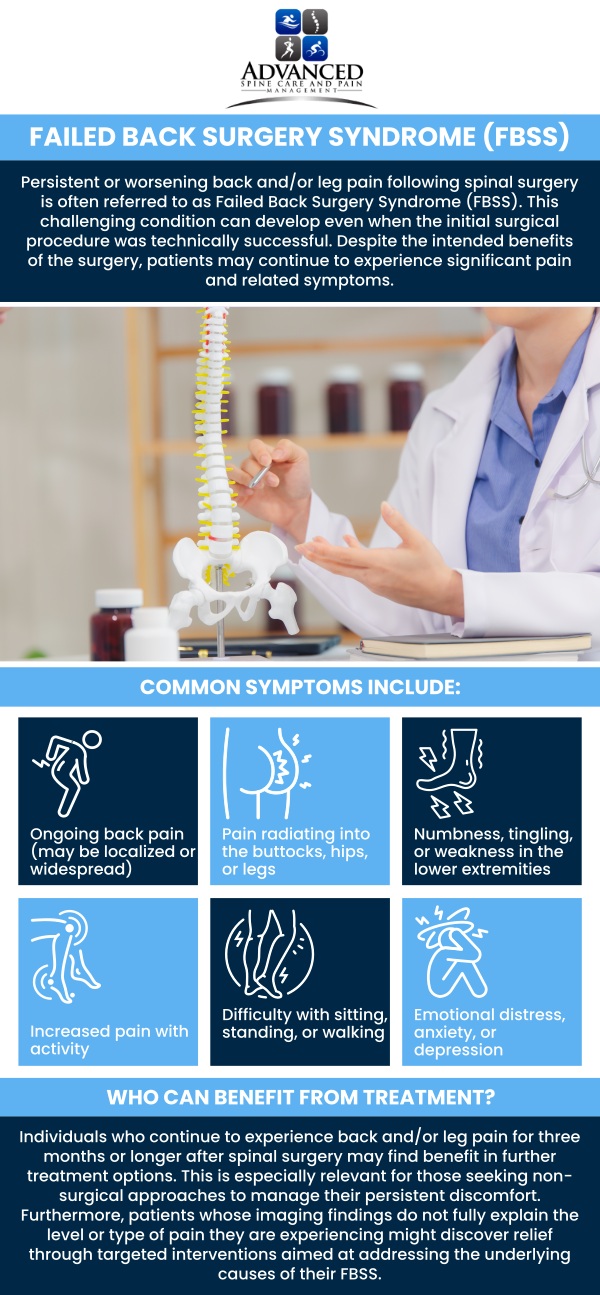
Table of Contents:
What treatments are available for failed back surgery syndrome (FBSS)?
What causes ongoing pain after back surgery, and how is FBSS diagnosed?
Can physical therapy and non-surgical treatments help manage failed back surgery syndrome symptoms?
Are spinal injections or advanced pain management options effective for FBSS?
When should I see a pain specialist for failed back surgery syndrome treatment?
How can Dr. Shailesh S. Pathare, MD provide personalized failed back surgery syndrome treatment options for patients in Staten Island, NY?
Treatment for FBSS does not follow a single pathway. The appropriate option depends on why symptoms remain, how severe they are, what treatments have already been attempted, and whether a correctable structural problem is present.
Depending on the evaluation, treatment may include medication management, targeted physical therapy, psychological support, injection-based procedures, radiofrequency ablation, or spinal cord stimulation. Revision surgery may also be considered in selected situations when an identifiable anatomical problem can be corrected surgically.
At Advanced Spine Care & Pain Management, our team considers the patient’s previous surgery, current symptoms, and treatment history when determining which pain management options may be appropriate.
Pain that continues after spine surgery can have more than one possible explanation. Symptoms may persist because the original pain generator remains, another spinal problem has developed, nerve-related symptoms continue, or the surgical outcome has not fully addressed the source of discomfort. Determining the cause requires more than simply reviewing the fact that surgery occurred.
The evaluation may involve a detailed discussion of the patient’s symptoms and previous procedures along with a physical examination and diagnostic testing when indicated. Understanding where symptoms occur, how they behave, and how they affect movement and daily activities can help guide further assessment.
At Advanced Spine Care & Pain Management, our team works to identify the factors contributing to persistent post-surgical symptoms before recommending a treatment strategy.
Non-surgical care can be useful for some people with persistent symptoms following spine surgery. Depending on the individual situation, treatment may include customized physical therapy, medication management, targeted injections, and other pain management approaches.
The purpose of conservative treatment is not necessarily to use one technique indefinitely. Instead, different approaches may be considered according to how the patient responds and what is contributing to the symptoms. Treatment can be adjusted when an approach is not providing the desired level of improvement.
At Advanced Spine Care & Pain Management, our team develops non-surgical treatment recommendations around the patient’s symptoms, previous care, physical capabilities, and personal treatment goals.
Spinal injections and other interventional procedures may be considered when persistent pain appears to involve specific spinal structures or nerve pathways. The clinic’s published FBSS treatment options include trigger point injections, medial branch nerve blocks, and epidural steroid injections, along with radiofrequency ablation and spinal cord stimulation for selected patients.
These treatments are not equally appropriate for everyone. The potential role of an injection or advanced procedure depends on the suspected pain source, previous treatment response, overall health, and findings from the evaluation. Some patients may require a less invasive approach, while others may be evaluated for more advanced interventions.
At Advanced Spine Care & Pain Management, our team reviews each patient’s individual presentation before recommending whether an injection or advanced pain management option should be considered.
Consider speaking with a pain specialist when pain continues after spine surgery, returns after an initial period of improvement, or begins interfering with sleep, movement, work, or everyday activities. Persistent symptoms that have not responded adequately to previous treatment can also warrant a more specialized evaluation.
A pain specialist can review the history of the surgery and previous treatments while looking more closely at the current pattern of symptoms. This can help determine whether additional conservative care, an interventional procedure, advanced pain management, or another evaluation may be appropriate.
At Advanced Spine Care & Pain Management, our team evaluates persistent post-surgical pain and helps patients understand potential treatment pathways based on their individual circumstances.
Triple board-certified Dr. Shailesh S. Pathare approaches FBSS by looking beyond the fact that a patient has already undergone spine surgery. Understanding what the patient continues to experience, what procedures have already been performed, and which treatments have or have not helped provides important context for deciding what should be considered next.
Dr. Pathare can discuss a range of pain management strategies, including medication management, targeted injections, radiofrequency procedures, and spinal cord stimulation when appropriate. The clinic also recognizes that revision surgery should be carefully considered when there is a specific anatomical problem that may be corrected.
At Advanced Spine Care & Pain Management, Dr. Shailesh S. Pathare, MD, and our team provide personalized failed back surgery syndrome treatment options for patients in Staten Island, NY, with recommendations based on their symptoms, medical history, previous procedures, and individual goals. For more information, contact us today or book an appointment. We are conveniently located at 565 Jewett Avenue, Staten Island, NY 10302. We proudly serve patients from Prince’s Bay NY, Midland Beach NY, Todt Hill NY, St. George NY, Westerleigh NY, Dongan Hills NY, and surrounding Staten Island areas.
Check Out Our 5 Star Reviews



Additional Services You May Need
▸ Back Pain Treatment
▸ Neck Pain Treatment
▸ Sciatica Pain Treatment
▸ Pinched Nerves Pain Treatment
▸ Herniated Disc Treatment
▸ Radiculopathy Treatment
▸ Facet Joint Pain Treatment
▸ Trigger Point Injections
▸ Spinal Stenosis Treatment
▸ Pain Despite Injections
▸ Work-related Injuries Treatment
▸ Pain Management


 Send Text
 How May I Help You?