


How Does Radiofrequency Ablation Treat Medial Branch Nerve Pain?
At Advanced Spine Care & Pain Management Staten Island, NY, patients receive personalized guidance for understanding Radiofrequency Ablation as a treatment option for medial branch nerve pain. Dr. Shailesh S. Pathare, MD, a triple board-certified physician, focuses on evaluating each patient’s condition, symptoms, and pain patterns to determine the most suitable approach. Our clinic provides comprehensive pain management care using advanced techniques to help patients explore effective options for managing chronic spine-related discomfort and improving daily function. For more information, please contact us or book an appointment online. Our clinic is conveniently located at 565 Jewett Avenue, Staten Island, NY 10302.
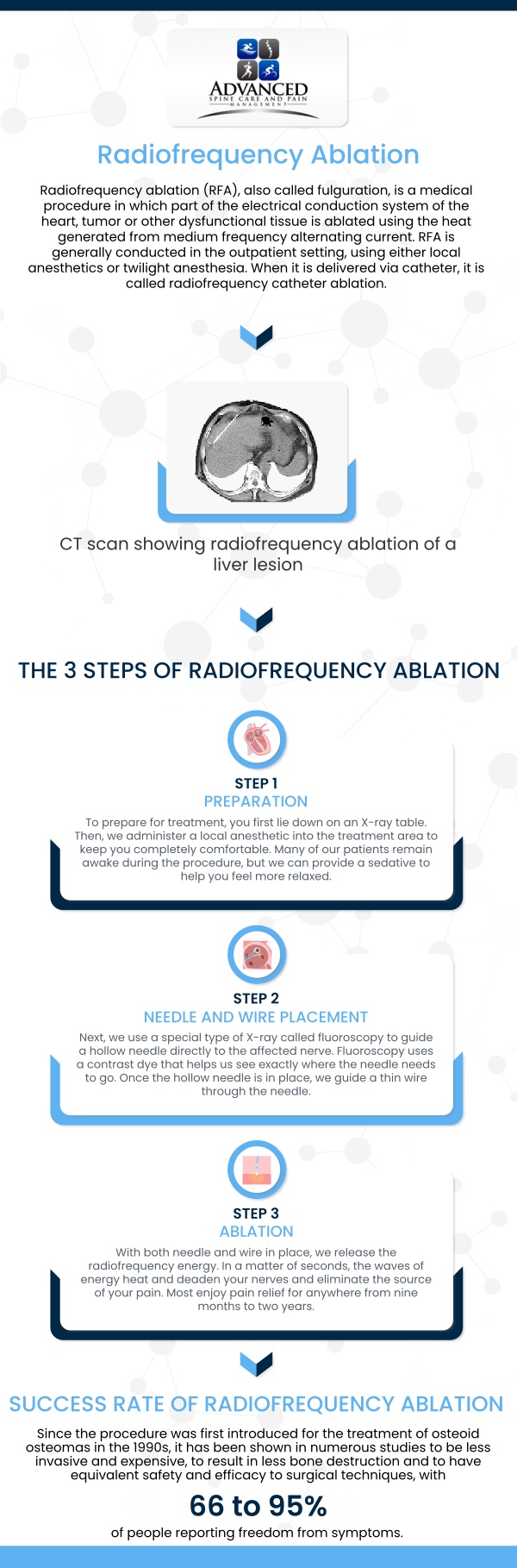
Table of Contents:
What is radiofrequency ablation for medial branch nerve pain?
How does radiofrequency ablation help reduce back or neck pain?
Am I a good candidate for medial branch nerve RFA?
How long does pain relief last after radiofrequency ablation?
How can Dr. Shailesh S. Pathare, MD, help patients explore whether radiofrequency ablation is the right option for managing medial branch nerve pain?
Radiofrequency ablation (RFA) is a minimally invasive procedure designed to help manage pain caused by irritated medial branch nerves that transmit signals from the facet joints in the spine. These small nerves can contribute to chronic neck or back pain when the facet joints become a source of discomfort.
During the procedure, controlled radiofrequency energy is used to create heat near the targeted medial branch nerves, temporarily interrupting their ability to send pain signals to the brain. This approach does not remove the nerves but helps reduce pain communication from the affected area.
Our team focuses on helping patients understand their condition and available treatment options before considering RFA. At Advanced Spine Care & Pain Management Staten Island, NY, we provide personalized evaluations to determine whether radiofrequency ablation may be an appropriate option for medial branch nerve pain.
Radiofrequency ablation helps reduce back or neck pain by targeting the medial branch nerves responsible for carrying pain signals from the facet joints. By reducing the transmission of these signals, the procedure may help decrease discomfort and improve daily function for eligible patients.
The treatment is often considered after other diagnostic steps, such as targeted nerve blocks, indicate that the facet joints may be contributing to pain. RFA may provide longer-lasting relief compared with temporary procedures for some individuals.
Our team works closely with patients to understand their symptoms, medical history, and treatment goals when exploring pain management options. Our team offers comprehensive care to help patients evaluate whether radiofrequency ablation may support their long-term pain relief goals.
A good candidate for medial branch nerve RFA is typically someone experiencing chronic neck or back pain that may be related to facet joint discomfort and has responded positively to diagnostic medial branch nerve blocks. A thorough evaluation helps determine whether the pain source matches the nerves targeted during the procedure.
Patients may be considered for RFA when conservative approaches have not provided enough relief and when testing suggests that the facet joints are contributing to their symptoms. Individual factors, including overall health and specific pain patterns, are reviewed before recommending treatment.
Our team evaluates each patient’s condition carefully to develop a personalized approach to pain management. Our team helps patients to receive guidance on whether the medial branch nerve RFA aligns with their needs and treatment objectives.
The duration of pain relief after radiofrequency ablation can vary depending on the individual, the underlying condition, and how the body responds to treatment. Many patients experience relief for several months, while others may experience longer-lasting improvement.
Over time, medial branch nerves may naturally regenerate, which can allow pain signals to return. If symptoms recur and the patient remains an appropriate candidate, additional evaluation may help determine the next steps in care.
Our team helps patients understand expected outcomes and follow-up considerations after RFA. Advanced Spine Care & Pain Management Staten Island, NY provides ongoing support to help individuals manage medial branch nerve pain with a treatment plan tailored to their condition.
Dr. Shailesh S. Pathare, MD, a triple board-certified physician, helps patients explore radiofrequency ablation by evaluating their symptoms, medical history, and previous treatment responses. He considers whether the medial branch nerves and facet joints may be contributing to chronic spine-related pain.
Through a detailed assessment, Dr. Pathare can discuss available treatment options and help patients understand the potential benefits and considerations of RFA. His approach focuses on creating an individualized care plan based on each patient’s specific pain concerns and goals.
Our team is committed to providing personalized guidance throughout the pain management process. Advanced Spine Care & Pain Management Staten Island, NY helps patients make informed decisions about whether radiofrequency ablation may be a suitable option for managing medial branch nerve pain. For more information, please contact us or book an appointment online. Our clinic is conveniently located at 565 Jewett Avenue, Staten Island, NY 10302. We proudly serve patients from Prince’s Bay NY, Midland Beach NY, Todt Hill NY, St. George NY, Westerleigh NY, Dongan Hills NY, and surrounding Staten Island areas.
Check Out Our 5 Star Reviews



Additional Services You May Need
▸ Back Pain Treatment
▸ Neck Pain Treatment
▸ Sciatica Pain Treatment
▸ Pinched Nerves Pain Treatment
▸ Herniated Disc Treatment
▸ Radiculopathy Treatment
▸ Facet Joint Pain Treatment
▸ Trigger Point Injections
▸ Spinal Stenosis Treatment
▸ Pain Despite Injections
▸ Work-related Injuries Treatment
▸ Pain Management


 Send Text
 How May I Help You?